 Human Cheatcodes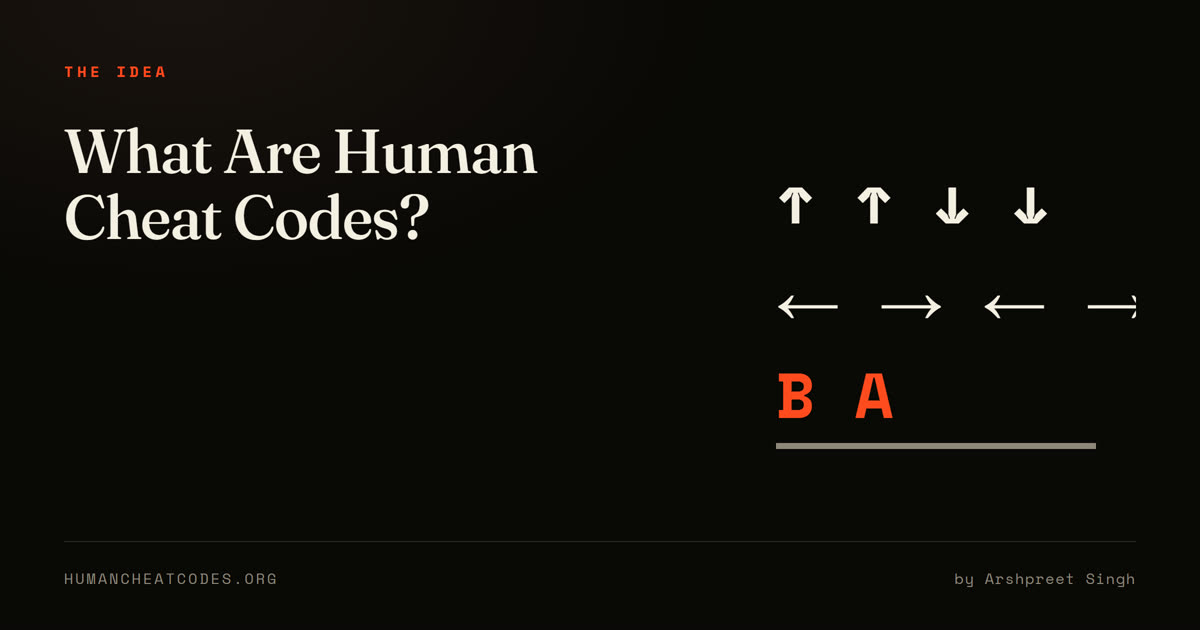
In a video game, a cheat code is a short sequence that makes the game do something it would not otherwise do. People are not games — but they are far more predictable than we like to admit. A human cheat code is the same idea applied to behaviour: a pattern that reliably produces a reaction, with a name on it so you can see it coming.
The definition
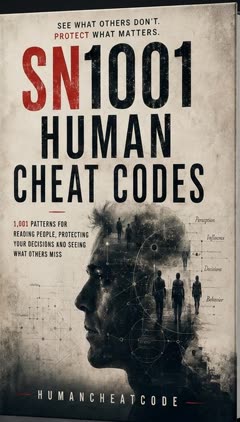
The shortest version is the one printed at the start of SN1001: a cheat code is a pattern with a name on it. Not magic, not hypnosis, not power over anyone. Just an observation about how people respond, written down precisely enough that you can recognise it — first in other people, then in yourself.
The reason it works is that most of what decides a conversation is not the words. People respond to timing, to where your eyes go, to how long you pause, to who you look at when you laugh — and to what all of that tells them about their own position: am I safe with this person, am I above or below them, do they see me? Almost nobody chooses those responses consciously, which is exactly why they repeat. The same move tends to produce the same reaction in Mumbai, Manchester and Milwaukee, in boardrooms and kitchens.
Real examples
A few codes from SN1001, each shortened — the book carries the full reasoning:
Let your eyes rest on someone's lips for a few seconds while they talk, then come back to their eyes. It reads as interest, often attraction. Limit: it needs warm ground — in a formal room it becomes pressure.
Nobody asks you for the big thing first. They ask for a tiny thing, and each small yes becomes a lever for the next, because people fight to stay consistent with what they have already done. Watch for staircases: an oddly easy first step usually has the rest of the flight built behind it.
A price is not a fact. Almost every salary band, quote or "standard rate" was invented by a person, with a range built in. So anything with a human on the other end is askable — and the worst realistic outcome of a polite request is a polite no.
Anxiety is internal, vague and about the future. Fear is a sudden response to something present — a specific person, right now. They need opposite responses. The test: was I fine until this specific thing happened? If yes, it isn't anxiety. It's an assessment.
Why every code has a limit
The internet is full of "psychology tricks" that promise to make anyone like you, trust you or obey you. They do not work like that, and the people selling them know it. A pattern that helps in one room backfires in another. So every code in SN1001 carries its limit, printed right next to it — because, as the book puts it, a trick without its limits "isn't knowledge. It's a thing you saw online once."
Some codes are also honest about what they are. A few are pressure tools, and they are labelled that way: included so you can recognise them being done to you, not so you can run them on people who trust you.
What human cheat codes are for
Seeing the game
Every conversation runs two games at once: the visible one, made of words and tasks, and an invisible one about status, belonging, safety and control. Most people play the first and lose the second without knowing it existed. Codes make the second game visible. The Unfair Advantage is built around exactly this idea.
Not getting played
The most valuable codes are defensive: gaslighting, guilt trips, manufactured urgency, the invisible crowd who "all agree". Named, each one loses most of its grip.
Saying what you mean
Some codes are simply better words. My Turn is the book of those: ninety-four scripts for the people who take too much.
Human Cheat Codes started as a page of short psychology videos on Instagram and Facebook, founded by Arshpreet Singh. The first forty codes in SN1001 are the ones that built that page — now written out with the reasoning and the limits a thirty-second video can't carry.
Where to start
- Want the whole picture in one sitting? The Unfair Advantage — eleven chapters, about two hours.
- Want the full library of codes? SN1001 — all 1,001, searchable. See what is inside.
- Want the words for saying no? My Turn — see what it covers.
Read a complete chapter of The Unfair Advantage, SN1001 or My Turn before you decide anything.
Choose a free chapter →Common questions
What are human cheat codes?
Patterns of behaviour with a name on them — moves that reliably produce a reaction, written down so you can recognise them in others and in yourself.
Are human cheat codes manipulation?
They can be used that way, which is why they are worth knowing. Most of the value is defensive: named, a move loses most of its power. Every code in SN1001 states its limits.
Who is behind Human Cheat Codes?
A psychology brand founded by Arshpreet Singh: short videos, a free blog, and three books sold direct from this site.
Where should I start?
Read a free first chapter. The Unfair Advantage is the overview, SN1001 the full reference, My Turn the book for boundaries.