 Human Cheatcodes
SN1001 — Human Cheat Codes is the big one: 646 pages, twenty chapters, and one thousand and one numbered patterns for reading people, protecting your decisions and seeing what others miss. This is what is in it, how each code is written, and how people actually use it.
The idea in one line
The book defines its own subject in a single sentence: "A cheat code is a pattern with a name on it." Not magic, not hypnosis, not power over anyone. Each code is a piece of behaviour that reliably produces a reaction, written down so you can see it — first in other people, then, as the book puts it, "uncomfortably, in yourself."
The first forty codes are the ones that built the Human Cheat Codes page — the short videos millions of people stopped scrolling for. What a thirty-second video can never carry is the part the book is really about: why each pattern works, when it doesn't, and what the people who use it well understand that everyone else misses.
How every code is written
Every one of the 1,001 entries follows the same shape: a number, a name, the move itself, why it works — and its limit. Here is the very first one, exactly as printed:
While someone's talking, let your eyes rest on their lips for a few seconds, then come back up to their eyes. They'll read it as interest — often as attraction — and they won't be able to tell you why. The limit: it needs warm ground. On a stranger who already feels watched, or in a formal room, the same look stops being interest and becomes pressure. This is a dial, not a button.
That last line matters. The book is blunt that a trick without its limits "isn't knowledge. It's a thing you saw online once." Some codes are also labelled honestly as pressure tools — included, in the book's words, "so you can recognise it being done to you."
What is inside, part by part
Part One · Seeing
1. The Ones That Built the Page (codes 1–40) — the codes from the original videos, now with the reasoning and the limits.
2. Body Language (41–110) — what faces, hands, feet and timing actually tell you, and what they don't.
Part Two · The Dark Side
3. Manipulation (111–170) · 4. Gaslighting (171–220) · 5. Control (221–280) · 6. Lies & Deception (281–340) · 7. Narcissists (341–390). This is the defensive core of the book: the moves used to rewrite your memory, make you dependent, and keep you apologising — named clearly enough that you can spot them while they are happening.
Part Three · Power
8. Words That Win (391–450) · 9. Power & Status (451–510) · 10. Respect (511–550) · 11. Confidence (551–600) · 12. Charisma & Attraction (601–650). How rooms decide who matters, and the signals that shift that decision.
Part Four · The Arenas
13. Office Politics (651–710) · 14. Money & Negotiation (711–760) · 15. Fake Friends (761–810) · 16. Family Games (811–850) · 17. Dating & Relationships (851–900) · 18. Social Rooms (901–950). The same patterns, applied to the places you actually spend your life.
Part Five · The Edge
19. Dangerous People (951–990) — telling fear from anxiety, and recognising the few people who are genuinely unsafe.
20. The Inner Game (991–1,001) — turning the lens on yourself. The last code is simply called What to Do on Monday.
How to read it
Not front to back. The book says so itself: "Don't try ten of these tomorrow. Pick one, run it for a day, watch what happens." Most readers do three things:
- Read chapter one — it is free, and it teaches the way of looking the rest of the book depends on.
- Search when something happens. The online reader searches all 1,001 codes, so a hard meeting, a relative's guilt trip or a negotiation becomes a lookup, not a guess.
- Keep one code a day. Run it, notice it, move on. By the end of a month you are seeing the board most people never notice.
The Unfair Advantage is the two-hour read that explains the rules of people, power and influence as one argument — see what it covers, chapter by chapter. SN1001 is the reference that goes wide. Plenty of readers start with the first and keep the second open for everyday use.
Formats
SN1001 is sold direct from this site, and arrives instantly for the digital editions:
- Ebook — $34.99. The searchable online reader plus the PDF to keep.
- Audiobook — $39.99. About sixteen hours, with the text highlighting word by word as it is read.
- Ebook + Audiobook — $49.99. Both.
- Paperback — $79.99. Printed to order and posted, with tracking emailed when it ships.
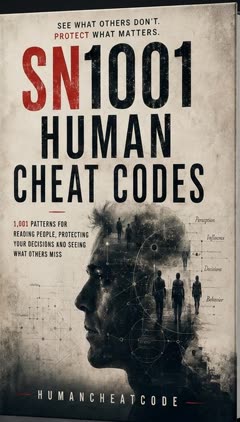
SN1001 — Human Cheat Codes: 1,001 patterns for reading people and protecting your decisions. Chapter One is free and complete.
Read chapter one free →All SN1001 editions and prices →
Common questions
What is SN1001?
A 646-page book by Arshpreet Singh with 1,001 numbered patterns of human behaviour, in twenty chapters across five parts. Each code names a pattern, explains why it works and states its limits.
Do I have to read it front to back?
No. It is a reference. Start with the free first chapter, then search the online reader for the situation you are in and use the code that fits.
What formats does it come in?
Ebook ($34.99), audiobook ($39.99, about sixteen hours), both ($49.99), and a printed paperback ($79.99). The first chapter is free.
How is it different from The Unfair Advantage?
The Unfair Advantage explains the rules as one two-hour argument. SN1001 goes wide: a thousand and one individual patterns you can look up in the moment.