 Human Cheatcodes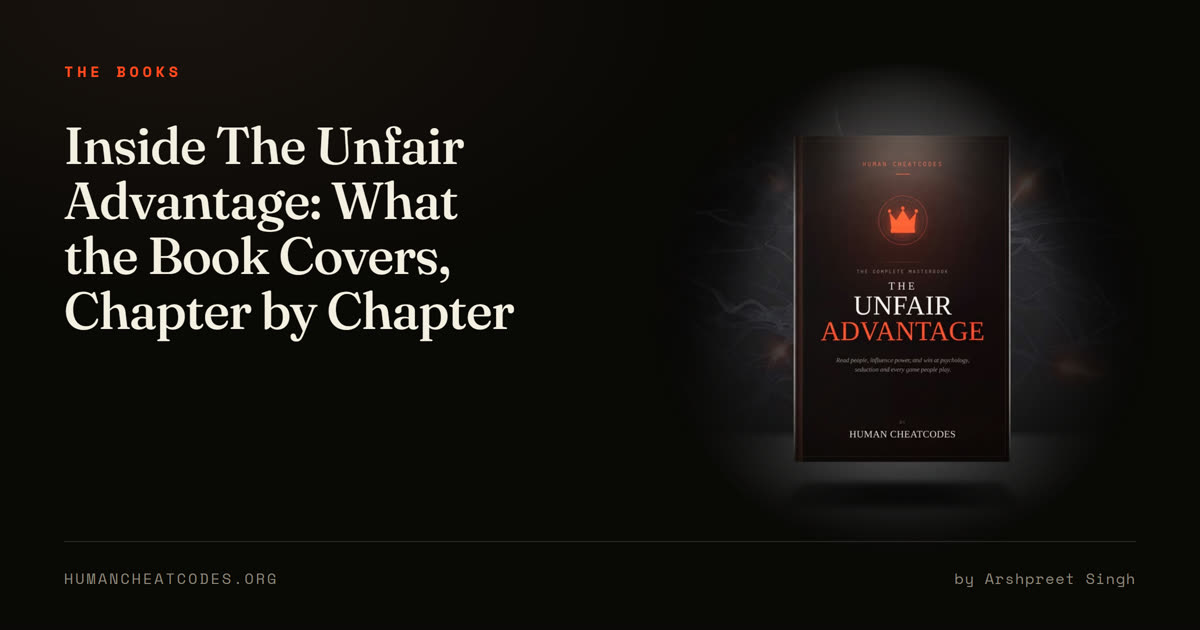
The Unfair Advantage is the Human Cheat Codes book on people, power and influence: the invisible rules of adult life that school skipped, decoded from more than two hundred psychology books into eleven chapters and one two-hour read. This is what is actually in it, chapter by chapter, so you can decide whether it is the book you are looking for.
There is another book called The Unfair Advantage, by Ash Ali and Hasan Kubba, about founders and start-ups. This is not that. This is the psychology book — how you get read, moved and quietly manipulated, and how to turn it around.
What the book is trying to do
Every interaction you have is running two games at once. The first is the visible one: the words, the tasks, the agenda. The second is invisible, and it decides the outcome — who has status, who belongs, who feels safe, who is in control. Most people spend their whole lives playing the first game and losing the second without ever knowing it existed. The book's job is to make the second game visible, and then to hand you the moves.
Every chapter is built the same way: a real story that shows the pattern, the psychology behind it, a summary of what you now understand, and a short list of cheat codes — lines and rules you can use the same day. It is written for general readers, not students.
Part one · See the game
Chapter 1 — You've Been Playing Without Knowing the Rules
The opening chapter names the pain most people cannot: the quiet day you realise everyone else was handed a manual you never received. You watched people who tried less get more, who knew less get believed more. This chapter explains why — the two games, and the four currencies the second one trades in: status, belonging, safety and control. Once you can see the board, you cannot stop seeing it.
Chapter 2 — Read Anyone
"Everyone is telling you the truth, constantly. Just not with their mouth." It opens with Clever Hans, the horse who could apparently do arithmetic, and what he was really reading. Words are the edited version; the body is live, and the old brain leaks through movement. The chapter is honest about the limits — pooled studies put human lie-detection near a coin flip — and teaches the method that works instead: baseline, change, cluster, and the topic on the table when the change appeared. The blog piece on how to read people is a short version of this chapter.
Chapter 3 — What People Actually Want
"Every want is a costume." It starts with New Coke — the most carefully researched decision in Coca-Cola's history, and one of its worst — to show that the stated want is real but rarely what is being bought. Everyone is starving for one of the four hungers more than the rest. Work out which, and you understand a person better than they understand themselves.
Part two · The games played on you
Chapter 4 — The Influence Machine
Six levers move the human animal: authority, scarcity, social proof, liking, reciprocity and consistency. The chapter follows a count with a briefcase of forged government stationery who checked into a Paris hotel in 1925 — and shows how each lever works by hijacking one of your four hungers. The machine does not create desire. It borrows yours. The post on persuasion techniques covers the honest use of the same levers.
Chapter 5 — The Manipulator's Playbook
"The last chapter's machine wanted your behaviour. The people in this one want your reality." It begins with the 1944 film that gave gaslighting its name, and makes the book's central argument about manipulation: it is not a bag of tricks but one project — to make you distrust your own instrument so you will borrow theirs. One fingerprint survives every disguise: after time with them, do you trust yourself more, or less? See also the ten gaslighting phrases and seven dark psychology tricks.
Chapter 6 — The Dangerous Few
"Almost no one is a monster. This chapter is about the almost." One to four people in a hundred run a life without conscience, which means most difficult people you meet are wounded rather than dangerous — and across a lifetime, you will still meet the few. The chapter is not about diagnosing anyone. It is about pattern-reading, so you recognise the few early enough for it to matter.
Chapter 7 — Power & Respect
"Nobody gives respect. Rooms read it." The chapter opens with a world-class violinist who filled a concert hall at a hundred dollars a seat, then played the same music in a subway station and was ignored. Rooms do not respond to quality; they respond to signals of quality. Two ladders reach the top — dominance, which is rented, and prestige, which is owned — and the chapter shows what each one costs.
Chapter 8 — Desire
"Love wants closeness. Desire wants distance. Nobody told you that you were managing two opposite forces." Built around the work of one of the most listened-to couples therapists in the world, this chapter explains why the spark dies in most relationships — they drown in closeness and call it losing the spark — and where desire actually lives.
Chapter 9 — The Circle
"Every argument you've ever lost was lost in the first four words." Starting from the Harvard study that followed hundreds of men for the whole of their lives, the chapter makes the case that the warmth of your close relationships predicts a long, healthy life better than wealth or success — and then shows the four words that quietly lose the people who outlast every job and most romances.
Chapter 10 — The Table
"Money frightens good people because it feels like conflict. It isn't." A negotiation is the second game with a price tag. Leverage belongs to whoever needs the deal least, and that person is not born — they are prepared, before the table, from alternatives, information and patience. The chapter's first cheat code is one most people have never followed: name your price, then close your mouth. Their discomfort is not yours to rescue.
Chapter 11 — The Inner Game
"You spent this whole book learning to read other people. The last person left to read is you." It opens with a king remembered as the wisest man who ever lived, whose own life was a catalogue of disasters — because up close, inside your own story, your instrument distorts. Between stimulus and response there is a gap, and the whole game lives there. The chapter teaches how to widen it: name the feeling, get distance, and ask what you would tell a friend.
Your Playbook
The closing section gathers every cheat code from the eleven chapters into one place — eleven frameworks, twenty-two practice scenarios, and, in the book's own words, one board you will never be able to un-see.
Who it is for
Anyone who has watched people with less effort, less skill and less honesty get more, and wanted the rules they were playing by. It is framed throughout as self-defence: learn it to stop being played, not to play people. Readers who want the encyclopaedic version — a thousand and one patterns rather than eleven chapters — should look at SN1001. Readers who want the scripts for saying no, holding a line and dealing with the people who take too much should start with My Turn.
Formats and how to read it
The ebook is 184 pages and reads in about two hours. It is sold direct from this site, and you get it instantly: an online reader that remembers your place, plus the PDF to keep. There is an audiobook, and a bundle of both. Every purchase is covered by a seven-day money-back guarantee.
The complete first chapter is free — not a sample, the whole chapter — so you can find out whether the book is for you before paying anything.
The Unfair Advantage — ebook $29.99, audiobook $35, bundle $40. Instant access, online reader plus PDF, 7-day money-back guarantee.
Read chapter one free →Full details, editions and reviews on the book page →
Common questions
What is The Unfair Advantage about?
The invisible rules of people, power and influence: how people read each other, what they actually want, the six levers that move them, how manipulators work, how respect is signalled, how desire behaves and how to hold your own at a negotiating table — decoded from over two hundred psychology books into eleven chapters and one two-hour read.
Is this the same as the start-up book by Ash Ali and Hasan Kubba?
No. That one is about founders. This is the Human Cheat Codes book on the psychology of people, power and influence.
How long is it and what formats are there?
184 pages, about two hours to read. Ebook ($29.99, online reader plus PDF), audiobook ($35), or both ($40). The first chapter is free.
Who is it for?
Anyone who has watched people with less effort and less honesty get more, and wanted the rules. Every chapter ends with a summary and cheat codes you can use the same day.