 Human Cheatcodes
"Reading people" covers several different skills: noticing what a body is doing, understanding what someone actually wants, hearing what sits under their words, and judging well when you are not sure. No single book does all of it. These do the most, and between them cover the whole skill.
Full disclosure: two books on this list are ours. They are marked.
Body language
What Every BODY Is Saying — Joe Navarro
A former FBI counter-intelligence agent on nonverbal behaviour, and the most grounded popular book on the subject. Navarro's best lesson is where to look: feet and legs are more honest than faces, and comfort and discomfort are easier to read than "lying". He is also careful to say that signals need context — a rare quality in the genre.
The Like Switch — Jack Schafer
Another former FBI agent, this time on the signals that make people warm to you — and how to read whether they are. Practical, conversational and useful for first meetings, sales and dates.
What people want, and how they are moved
Influence — Robert Cialdini
The research on why people say yes: reciprocity, commitment, social proof, liking, authority, scarcity and unity. Reading people is partly reading which of these is being used on the person in front of you — or on you.
Never Split the Difference — Chris Voss
A former FBI hostage negotiator on hearing what is underneath a conversation: labelling the emotion you can hear, mirroring, and asking questions that make the other person reveal what they actually need. Some of the most usable reading-people skills in any book, disguised as a negotiation manual.
The Laws of Human Nature — Robert Greene
The long view: character, envy, grandiosity, the masks people wear. Slow and historical, but it teaches you to read patterns over months, not moments.
Your own judgement
Thinking, Fast and Slow — Daniel Kahneman
The Nobel laureate's account of the two systems behind every judgement — fast intuition and slow reasoning — and the biases that come from trusting the first too much. Essential for reading people well, because most misreadings are really errors in the reader. For a short version, see twelve cognitive biases with everyday examples.
The practical toolkits
The Unfair Advantage — Arshpreet Singh (ours)
Chapter two of The Unfair Advantage is called Read Anyone. It starts with Clever Hans, the horse that appeared to do arithmetic, and is honest about the research: pooled studies put human lie-detection close to a coin flip. What it teaches instead is a method — how someone behaves normally, what changes, and the topic on the table when it changed. The rest of the book covers what people want, influence, manipulation and power, all in about two hours. See what is inside.
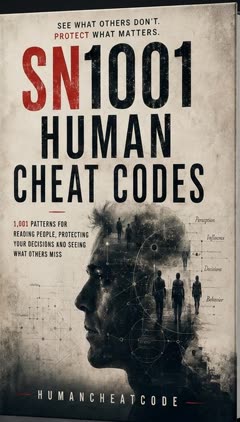
SN1001 — Human Cheat Codes (ours)
SN1001 is the reference: 1,001 numbered patterns, including seventy codes on body language alone and whole chapters on lies, power, status and social rooms. Every code states its limits. Most readers search it when something happens rather than reading it front to back. See what is inside.
Which to start with
- You want to read bodies: What Every BODY Is Saying.
- You want to understand what people want: Never Split the Difference.
- You want the whole skill, fast: The Unfair Advantage.
- You want something to look things up in: SN1001.
- You keep misjudging people: Thinking, Fast and Slow.
No book will make you a human lie detector, and the ones that promise to are wrong. The useful skill is noticing when something changes and asking a better question — see what actually holds up and nine signals that actually mean something.
The Unfair Advantage or SN1001 — a complete first chapter, no payment needed.
Choose a free chapter →Common questions
What is the best book on reading people?
For body language, What Every BODY Is Saying. For a practical overview, The Unfair Advantage. For a searchable reference, SN1001.
Can you learn to read people from a book?
Partly. Books teach what to watch for and what not to trust; the skill comes from practice — baselines, changes, and checking your read with a question.
Do body language books help you spot lies?
Less than people hope. Lie-detection accuracy is only slightly above chance, and no single gesture reliably signals deception.