Human Cheat Codes presents

Learn how people actually work.

The complete education in psychology as a science — the same ground a first degree covers, taught for the situations you live in every day. By the end you will read people, evidence and yourself with a precision most people never reach.

Apply now Start Level 0 free
Level 0 is free, no card needed  ·  About 100 hours of study, at your pace  ·  Certificate of Completion  ·  14-day guarantee
7levels
68full lessons
800checked sources
820exam questions
702dictionary terms
90real cases
Why this exists

Most psychology online is either exciting and wrong, or accurate and abandoned by week three. You come away more confident and less accurate. This is the third thing: the real subject, taught properly, with every claim graded.

You’ve watched the videos.

Body-language tricks, “7 signs of a narcissist”, the 7-38-55 rule. Some of it is wrong, some of it is half-right, and you have no way to tell which. So you carry all of it.

You’ve tried the books.

Good ones exist. But a book can’t test you, can’t make you write the analysis before it shows you the answer, and can’t tell you where the field has moved since it was printed.

You still can’t answer the question.

When someone says “psychology says…”, you don’t know what to ask. When your sister, your manager or your partner does something baffling, you don’t know what you can and can’t conclude. That is what this fixes.

What changes

Who you are on the last day.

This is not a list of terms to memorise. It is a way of thinking that, once you have it, you cannot switch off.

Before

  • You react to people, then explain the reaction afterwards.
  • “Studies show” ends the argument.
  • Personality quizzes feel like measurement.
  • Someone’s behaviour tells you what kind of person they are.
  • You know a lot of psychology facts, and half of them are myths.
  • Difficult people are a mystery you keep re-living.

After

  • You separate what you saw from what you concluded, automatically.
  • You ask: measured how, compared with what, on whom, how big?
  • You know what reliability and validity are, and why most quizzes have neither.
  • You weigh the situation against the person before you judge either.
  • You can grade any claim: strong, moderate, emerging, contested, or myth.
  • You recognise the pattern, name the mechanism, and know what you can’t conclude.
What you’ll be able to do

Eight things you can’t do now.

Read a research paper

Open a psychology study and tell what it actually shows, who was studied, how big the effect is, and whether it has held up.

Grade any claim

Hear “psychology says” and know, in seconds, whether the evidence behind it is strong, thin or invented.

Spot the myths

The 31 most-repeated psychology myths, taken apart one by one: claim, evidence, what we actually know, what remains uncertain.

Analyse a real situation

Ninety cases, from a withdrawn employee to a family argument: what applies, what’s missing, what else explains it, what you would never conclude.

Understand influence

How persuasion, conformity and authority actually work, mechanism by mechanism, so you recognise it when it’s aimed at you and hold your ground.

Understand your own mind

Memory, attention, emotion, motivation and the biases that run your decisions, with the honest evidence on how much you can change.

Know what mental health is

How the major conditions are understood, assessed and treated, taught for literacy and compassion, never for diagnosing the people in your life.

Think like a psychologist

The signature skill: take a viral claim, ask the seven questions a psychologist asks, and arrive at what can legitimately be said.

How it works

Every lesson has ten parts. Every concept goes through the loop.

Learn → Test → Apply → Analyse → Research → Discuss → Master. That strip sits at the top of every lesson, and nothing is marked complete until you have done the work.

LearnObjectives, then a short spoken introduction (read it or press Listen), then the written lecture with every term defined the first time.
SeeDiagrams and real-world examples. 190 diagrams across the Academy, drawn for the lesson they sit in.
AnalyseA case with an expert answer that only opens after you have written your own. That is where the learning happens.
TestAn 8-question knowledge check on every lesson, level quizzes, a 40-question midterm, a 45-minute practical, a 100-question Mastery Exam.
KeepAn exercise and a reflection per lesson. Highlights become flashcards; flashcards come back on a spaced schedule until you own them.

Eight videos from the instructor open the Academy and each level. Everything else is reading, writing and doing, because that is what the research on learning says works, and because a video you watch is not a skill you have.

The evidence labels

Every important claim carries one.

Strong

Multiple high-quality studies, meta-analyses, or successful replications. Rely on it — still ask about context and effect size.

Moderate

Reasonably supported, with real limitations: small effects, narrow contexts, correlational. A working assumption, not a law.

Emerging

Interesting evidence exists; conclusions are still developing. Be curious. Don’t build on it yet.

Contested

Findings are inconsistent, replications have failed, or the field is arguing. Know both sides. Never state it as fact.

Popular / Weak

Widely repeated, poorly supported. Recognise it — this is where most “psychology facts” live.

Some of the most famous findings in psychology are taught here as contested, with the modern re-evaluations named. If you can grade evidence, you are protected from every myth that hasn’t been invented yet.

What’s covered

Seven levels. Sixty-eight lessons. One path.

The levels go in order, because each one stands on the last. Inside the Academy nothing is unlocked by payment tier, only by the work you have done.

How long it takes

About a hundred hours. At your pace.

A full lesson takes 80 to 90 minutes with the case, the exercise and the check. There is no cohort clock. The Academy waits for you, and your progress follows you across every device.

3 months

At about eight hours a week. For someone who has decided this is the thing they are doing this season.

5–6 months

At four to five hours a week. Two evenings, or one long Sunday. This is the pace most people settle into.

A year

At two hours a week. Slow is fine. A lesson a week is still a real education by the end of it.

What you get

Everything on this list, the day you join.

The certificate

Earned, not given.

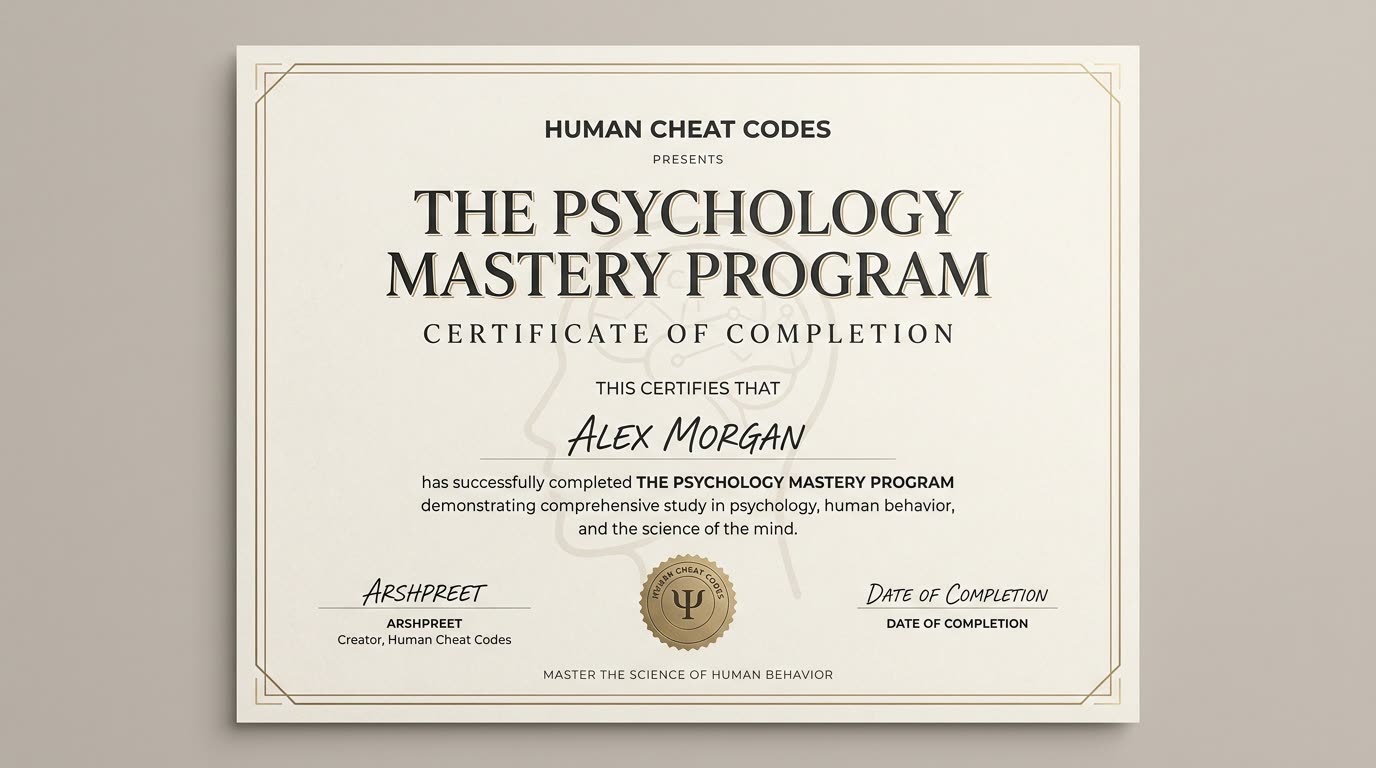
The Certificate of Completion — Comprehensive Foundations of Psychology — is issued when you have completed at least 80% of lessons, hold a quiz average of 70% or more, have passed the Mastery Exam and have submitted your capstone. It carries a unique ID.

Along the way you earn five student levels: Foundations, Human Behaviour, Psychological Analysis, Advanced Psychology, and Psychology Scholar. Each one is unlocked by finishing the work, never by time spent.

The certificate recognises completion of an educational programme. It is not a professional, clinical or licensing qualification.

The Psychology Mastery Program — Certificate of Completion
Who it’s for

And who it isn’t.

For

Intelligent adults with no psychology background who want to understand people — colleagues, family, customers, themselves — with far more accuracy than they have now. People who have read the popular books and want the real thing. People considering a psychology degree who want to know what it is before they pay for it. Coaches, managers, teachers, parents and carers who deal with people all day and want to stop guessing.

Not for

Anyone looking for tricks to control people. Anyone hoping to diagnose the people in their life. Anyone who wants a course they can finish in a weekend and forget by the next one. The Academy is a real education, and it asks real work of you.

Our promises

Seven things we hold ourselves to.

  1. Every claim traces to a source. 800 sources, each checked against a publisher, journal or library record, and a label on every important claim telling you how much weight it can bear. No fabricated statistics. Ever.
  2. No body-language myths, no manipulation how-tos. Influence is taught for recognition and defence. Non-verbal behaviour is taught with what it can and cannot tell you.
  3. Recognising is never diagnosing. That line is repeated through every level, is built into the tutor, and is the first rule of the community.
  4. Nothing to memorise for its own sake. Every quiz, test and assignment asks you to apply and reason. Questions are drawn at random from a bank of 820.
  5. The certificate means something. It cannot be bought, skimmed or clicked through. It is issued when the work is done, and its ID can be checked.
  6. A real person answers. Support is a human being, usually the same day. The AI tutor is there for the concepts; we are there for everything else.
  7. Fourteen days to change your mind. If it isn’t for you, and you’ve completed fewer than three paid lessons, you get a full refund. No forms, no questions.
Join the Academy

Level 0 is free. The rest is one payment of $249.

Not sure yet? Create a free account and start Level 0 now. Apply when you’re ready.

No subscription. No upsells inside. Everything on the list above, every level as it opens, and every update we make to the Academy from here on.

14days

Try it properly. Join, open Level 1, do the first two lessons the way they are meant to be done. If it isn’t what you hoped, email us within 14 days, before your third paid lesson, and we refund you in full.

The certificate recognises completion of an educational programme. It is not a professional, clinical or licensing qualification.

Instructor
Arshpreet Singh

Arshpreet Singh

Founder of Human Cheat Codes and author of The Unfair Advantage, My Turn and SN1001. He built the Academy because the psychology that spreads is rarely the psychology that holds up, and the psychology that holds up is rarely taught in a way you can use on a Wednesday. Every lesson was written from the sources, then independently audited, before it went in.

@humancheatcodes_
Questions

Before you join.

Do I need any background in psychology?

No. Level 0 and Level 1 assume nothing. Every term is defined the first time it is used, and the dictionary is one click away from any word.

How much time does it take?

About a hundred hours in total. Most people do four to five hours a week and finish in five or six months. There is no deadline, and the Academy remembers exactly where you were.

Is it live? Are there set times?

No. Everything is on demand. There are eight short recorded videos, and every lesson can be read or listened to.

What is free?

Level 0, Orientation: the map of the field, how the Academy works, the evidence labels and the learning loop. Create an account and it is yours. Everything from Level 1 onward opens with membership.

Why do the levels go in order?

Because Level 1 teaches you how to read evidence, and every level after it is built on that. Inside a level you can move freely.

What about Level 4, mental health?

Level 4 teaches mental-health literacy: how conditions are understood, assessed and treated. It never trains anyone to diagnose, and it opens once a qualified clinician has signed it off. Until then it shows “Opening soon”. Everything else is open now.

Is this a professional qualification?

No. The certificate recognises completion of an educational programme. It is not a professional, clinical or licensing qualification. It is designed to change how you read people and evidence, not to qualify you to practise.

Does my progress save?

Yes, to your account. Sign in on your phone, your laptop or a library computer and you carry on where you stopped.

What if it’s not for me?

Full refund within 14 days of joining if you have completed fewer than three paid lessons. After that we don’t refund, because by then the materials have been delivered.

Can I pay in instalments?

Not at the moment. It is one payment, and there is no subscription.

Will this help with a specific person in my life?

It will help you understand what is happening and what you can and can’t conclude, and the 22 applied lessons are built around exactly those situations. It is education, not therapy, and the Academy is clear about that line.
Level 0 is open now. Free.

Start with Level 0 today, free. Create an account and the Roadmap is yours in a minute. When you want every level, apply, and they open the same minute you pay.

No card needed for Level 0. Joining takes about three minutes.